The book this site promised in 2010.
Named in a July 2010 essay, down to the subtitle. Published sixteen years later.
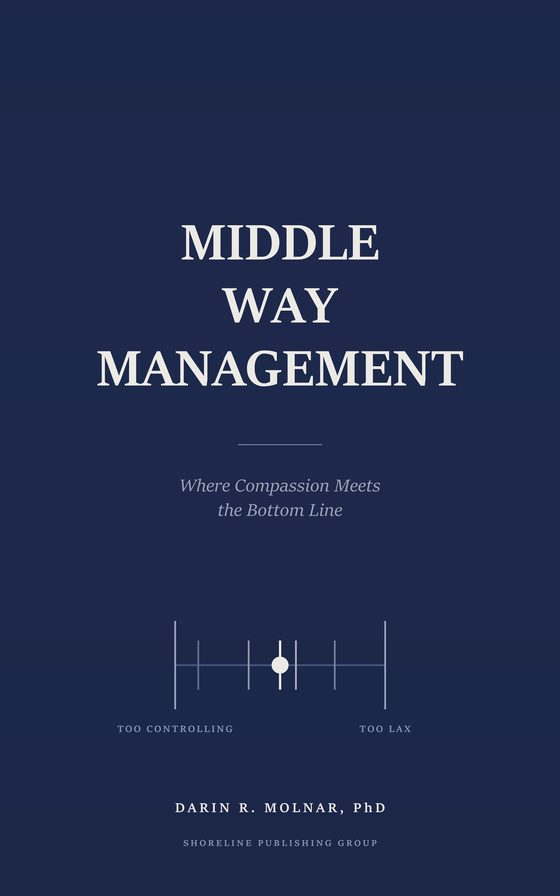
Forty-one essays, a validated instrument, and thirty years in the job, worked into a single argument you can read straight through. It refuses both extremes an American organization offers a manager. Control produces fear, and fear produces bad work. Abdication produces chaos — a genuinely kind chief executive who holds no one to anything can bleed forty percent of his people a year. The middle is not the average of those two. It is a third thing, and it is harder than either.
It is written for the manager with eleven people, a number to hit, a boss with a boss, and a mortgage. It is a practice for the building you are actually in, not the one you would have designed.
191 pages, 6 × 9. Shoreline Publishing Group, September 2026. Links go to Amazon.
As I’ve worked these past few months on producing the seminal book on Middle Way Management, Middle Way Management: Where Compassion Meets the Bottom Line, I came to the realization that the approach is about one thing: Compassion.
Middle Way Management and Compassion, July 5, 2010
That is the whole title, written down in the middle of the archive before the book existed. The essays ran on until June 2013 and then stopped. This is the book they were for.
Twenty-six chapters in four parts, and five appendices.
- Part One
The Argument
What the practice actually claims, the five precepts it rests on, the five assumptions people bring to it, and why it is not a soft approach.
- Part Two
The Practice
Where it starts, which is with yourself: the anchor, reflective thought, the magic mirror, boundaries and the word no, equanimity under creative tension.
- Part Three
The Hard Cases
Holding someone accountable without cruelty. The team member you cannot reach. Managing up when your boss is not decent. Fear. Whether to stay.
- Part Four
Measurement and Method
The instrument and what it measures, how a habit actually changes, the eight cognitive domains, and a straight accounting of what the 2009 argument got wrong.
The appendices carry the working material: the twenty-five items of the MWM-AI with its scoring, the eight cognitive domains, the eleven practices, the precepts and percepts in full, and a source note for every chapter.
Everything the book is built from is on this site, complete and at no cost: all 41 essays in the order they were written, the study behind the instrument, and the instrument itself. Nothing has been moved behind the book.
What the book adds is a single pass through the whole argument, in order, with sixteen years of hindsight applied to it — including the places the original claims did not survive contact with the evidence. If you would rather have the raw material, start here instead.